

Before You Donate: Understanding a Qualified Appraisal for Form 8283
A Qualified Appraisal for Form 8283 may become necessary when donating business assets, machinery, medical equipment, vehicles, or other tangible property to a qualified charitable organization. While most people think of charitable donations as dropping off clothing, writing a check, or contributing household goods to a local nonprofit, donations involving higher-value noncash property follow a very different process.
Over the years, we’ve received calls from business owners, attorneys, CPAs, and individuals who all ask a similar question: “I donated this property. Do I need an appraisal?” Unfortunately, the answer isn’t always straightforward.
A qualified appraisal for Form 8283 isn’t simply about assigning a value to donated property. It’s one part of documenting a charitable contribution under IRS requirements, and there are often tax considerations that fall outside the appraiser’s role. Understanding how the appraisal fits into the overall process can help donors avoid surprises and make the experience much smoother.
What Is a Qualified Appraisal for Form 8283?
A qualified appraisal is an independent opinion of fair market value prepared by a qualified appraiser for certain noncash charitable contributions. When required, the appraisal provides the supporting documentation used in connection with IRS Form 8283, Noncash Charitable Contributions.
Unlike a simple estimate or an online pricing search, a qualified appraisal documents the property being donated, explains the valuation methodology, and supports the value conclusion through market research and analysis. The report must also satisfy specific IRS requirements regarding its content and timing.
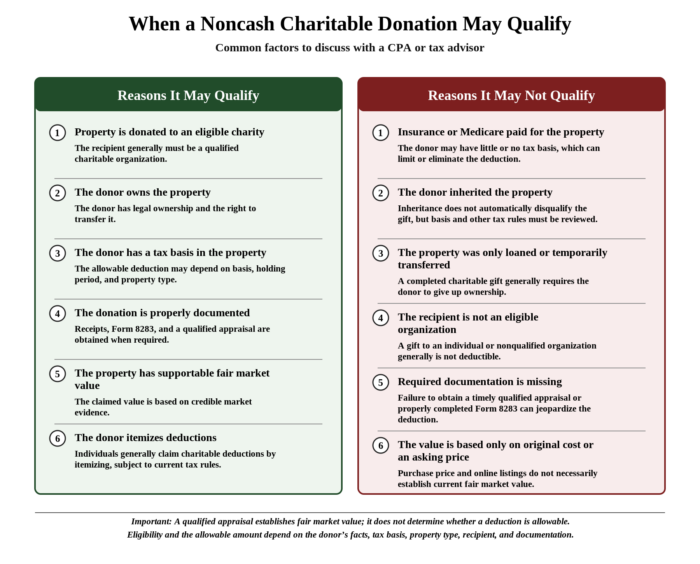
Perhaps the most important thing to understand is that the appraisal establishes fair market value. It does not determine whether a taxpayer is entitled to claim a charitable deduction or how much of a deduction may ultimately be allowed. Those are tax questions that should be answered by a CPA or other qualified tax professional.
Why the IRS Requires a Qualified Appraisal
The IRS recognizes that determining the value of noncash property is often far more complicated than valuing publicly traded securities or cash donations.
Consider the difference between donating a publicly traded stock and donating a five-axis CNC machining center, a mobile MRI unit, or a specialized piece of construction equipment. There may only be a limited number of comparable sales available, and factors such as age, condition, remaining useful life, configuration, and market demand can significantly influence value.
A qualified appraisal provides an independent, well-supported opinion based on accepted appraisal methodology rather than assumptions or estimates.
Not Every Donation Is the Same
One misconception we encounter is that every donated asset follows the same path.
In reality, charitable donations can involve an enormous variety of property, including:
- Manufacturing machinery
- Construction equipment
- Medical and laboratory equipment
- Restaurant equipment
- Commercial vehicles
- Farm equipment
- Aircraft
- Machine tools
- Industrial inventory
- Business assets used in an ongoing operation
Each asset category has its own marketplace, buyer pool, and valuation considerations. A piece of equipment that sells every week at auction is analyzed differently than a highly specialized machine that may only trade privately every few years.
That is one reason why selecting an appraiser familiar with the type of property being donated is so important.
What Does the Appraiser Actually Do?
Many people assume an appraisal begins with assigning a value. In reality, valuation is one of the last steps in the process.
The appraiser’s first responsibility is to correctly identify the property. That often involves reviewing photographs, invoices, equipment lists, serial numbers, manufacturer information, and other supporting documentation. Depending on the assignment, the appraiser may also perform an on-site inspection to verify identifying characteristics and observe the property’s physical condition.
Only after the property has been properly identified does the research begin.
Comparable sales, dealer offerings, auction activity, replacement cost information, and market trends are analyzed to determine how similar property is bought and sold in the marketplace. The appraiser then applies the appropriate valuation methodology based on the available market evidence and develops an opinion of fair market value.
Where Many Donors Become Confused
The appraisal itself is usually the straightforward part of the assignment.
The confusion often comes from assumptions about whether a charitable deduction is available in the first place.
Here are several situations we regularly discuss with prospective clients.
“Insurance Paid for My Power Wheelchair”
This is one of the most common questions involving medical equipment.
A donor may have received a power wheelchair, hospital bed, mobility scooter, or patient lift through private insurance, Medicare, or another healthcare program. Years later, the equipment is no longer needed, and the donor wishes to give it to a charitable organization.
Many people assume that because the equipment still has value, they automatically qualify for a charitable deduction.
Not necessarily.
The equipment may indeed have measurable fair market value, and an appraiser can determine that value. However, how the property was originally acquired and other tax considerations may affect whether a deduction is available and how it is calculated.
This is an excellent example of why the appraiser and the CPA have different roles. The appraiser develops the opinion of value. The CPA determines how that value applies under the Internal Revenue Code.
“I Inherited This Equipment”
Inherited property creates another area of misunderstanding.
Perhaps you inherited a tractor from your parents, a collection of machine tools from a family business, or manufacturing equipment from an estate. You later decide to donate those assets to a qualifying charitable organization.
Ownership alone does not determine how the donation will be treated for tax purposes.
Inherited property can involve questions regarding tax basis, holding period, and other IRS rules that fall outside the scope of the appraisal assignment. A qualified appraisal documents fair market value, but it does not determine the tax treatment of the donation.
“The Charity Accepted It, So I Must Be Able to Deduct It”
Acceptance by a charitable organization and eligibility for a tax deduction are two different issues.
Many charities gladly accept donated equipment because it supports their mission or helps raise funds. Whether the donor qualifies for a charitable deduction depends on IRS rules, not simply on whether the charity accepted the property.
“I Paid $200,000 for This Machine”
Original purchase price often has little relationship to current fair market value.
Markets change. Technology advances. Equipment becomes obsolete. Demand rises and falls.
We’ve appraised machinery that sold for more than its original purchase price because it became difficult to replace. We’ve also appraised equipment that lost significant value despite being well maintained because newer technology dramatically changed the marketplace.
Fair market value reflects today’s market, not yesterday’s invoice.
“It’s Old, So It Can’t Be Worth Anything”
Age alone tells very little about value.
Some older equipment remains highly desirable because of its durability, simplicity, or continued demand in the secondary market. Other assets become functionally obsolete long before they wear out.
That is why appraisers rely on market evidence rather than assumptions based solely on age.
Timing Matters More Than Many People Realize
One of the easiest ways to complicate the charitable donation process is to wait until tax season before thinking about the appraisal.
By that point, important records may be difficult to locate, equipment may have already been delivered to the charity, or photographs and identifying information may no longer be available. In some cases, donors discover they needed documentation that should have been gathered months earlier.
If you believe your donation may require a qualified appraisal for Form 8283, discussing the matter with your CPA before the property changes hands is usually the best approach. Planning ahead allows the donor, appraiser, and tax advisor sufficient time to gather the necessary documentation, address any questions, and avoid last-minute filing issues.
Choosing the Right Qualified Appraiser
Not every appraisal assignment is prepared for the same purpose.
An appraisal prepared for financing, litigation, insurance, or financial reporting may have a different scope of work than one prepared for a charitable contribution. Likewise, an appraiser who specializes in residential real estate may not be the best choice for valuing industrial machinery, medical imaging equipment, or manufacturing assets.
Experience with the specific type of property being donated, familiarity with accepted appraisal methodology, and an understanding of IRS reporting requirements all contribute to producing a credible appraisal for its intended use.
Obtaining Your Qualified Appraisal for Form 8283
A qualified appraisal for Form 8283 is much more than a document that places a dollar amount on donated property. It is an independent opinion of fair market value prepared to support a noncash charitable contribution, and it plays an important role in the overall documentation process.
Just as importantly, donors should remember that an appraisal answers only one question: What is the property’s fair market value? Questions involving deductibility, tax basis, filing requirements, or the amount of any allowable charitable deduction should always be directed to a CPA or qualified tax advisor.
By planning ahead, maintaining good records, and involving the appropriate professionals early in the process, donors can help ensure that their charitable contribution is supported by the documentation required for their particular circumstances.
Contact us today to learn more about the process.
August 1, 2026 5:38 pm
Comments are closed here.