
Equipment In-Place Value
Equipment in-place value is an important concept in machinery and equipment appraisal. It considers the value of machinery in its current installed location, rather than assuming the equipment will be removed and sold separately.
For manufacturing facilities, processing plants, and industrial businesses, understanding this valuation concept can help support financing, business transactions, and asset management decisions.
Understanding Equipment In-Place Value
Equipment in-place value generally refers to the value of machinery and equipment as installed and available for use within an operating facility.
Unlike equipment valued for removal, an in-place valuation considers the machinery’s existing installation and its contribution to an operating system.
For example, a manufacturing facility may contain several interconnected machines that work together as a production line. Their value as part of an operating facility may differ from the value of the same machines sold individually for removal.
The exact definition of value must be established for each appraisal assignment. Fair Market Value in Place and Liquidation Value in Place, for example, involve different assumptions.
Factors That Affect Machinery In-Place Value
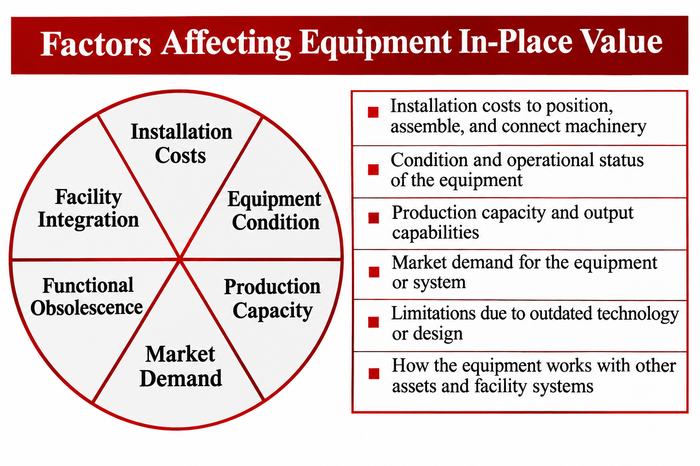
Several factors can influence the value of installed industrial machinery. Appraisers consider the equipment’s physical characteristics, operational capabilities, and relationship to the surrounding facility.
Important factors include:
- Installation Costs: Expenses associated with positioning, assembling, and connecting machinery.
- Equipment Condition: The physical and operational condition of the assets.
- Production Capacity: The equipment’s ability to perform its intended function.
- Market Demand: Buyer interest in the equipment or complete production system.
- Functional Obsolescence: Limitations caused by outdated technology, design, or operating efficiency.
- Facility Integration: How the machinery works with other equipment and existing infrastructure.
These factors help determine whether the equipment’s installed configuration contributes to its market value.
Equipment In-Place Value in Manufacturing Facilities
Manufacturing facilities often contain machinery that requires significant installation, specialized foundations, or electrical and mechanical connections.
Examples include CNC production lines, industrial presses, food processing systems, and automated packaging equipment.
Removing these assets may require substantial labor, transportation, and reinstallation expenses. Consequently, equipment sold for removal may produce a different valuation conclusion than machinery remaining in an operational facility.
Consider a food processing plant with a fully installed packaging line. The machinery may provide greater utility to a buyer acquiring the operating facility than to a purchaser planning to dismantle and relocate the equipment.
However, installation costs do not automatically translate into equivalent market value. The appraiser must evaluate whether market participants recognize the benefits of the existing installation.
Equipment In-Place Value and Collateral Lending
Machinery and equipment frequently serve as collateral for commercial financing. Lenders may request independent appraisals to better understand the value of assets securing a loan.
Depending on the financing arrangement, a lender may require Fair Market Value, Orderly Liquidation Value, or another defined basis of value.
An in-place valuation may be relevant when equipment is expected to remain installed and operational. However, lenders must also consider the possibility of default and the conditions under which collateral could be sold.
For example, a production line may have significant value within an operating facility, but that value could change if the business closes and the equipment must be removed.
Understanding these differences helps lenders evaluate collateral under appropriate market assumptions.
Businesses seeking professional valuations can learn more about machinery and equipment appraisal services provided by TMX Equipment Appraisal Group.
USDA Lending and Equipment Appraisals
The United States Department of Agriculture (USDA) supports several guaranteed lending programs designed to encourage investment in rural businesses, manufacturing, and processing facilities.
Programs administered through USDA Rural Development include the Rural Energy for America Program (REAP), Timber Production Expansion Guaranteed Loan Program (TPEP), and Strengthening Processing for U.S. Ranchers (SPUR).
These programs may support qualifying projects involving machinery purchases, facility improvements, and expanded production capabilities.
For example, the SPUR program is designed to support eligible meat, poultry, and seafood processing businesses. Eligible project uses include purchasing and installing machinery and equipment.
Under USDA guaranteed lending programs, participating lenders must evaluate collateral according to applicable program requirements and prudent lending practices.
An equipment appraisal may help establish an appropriate valuation conclusion for machinery used as loan collateral. However, an in-place valuation is not automatically required or accepted for every USDA financing assignment.
The appropriate value definition depends on the specific program, lender requirements, and intended use of the appraisal.
Additional information is available through USDA Rural Development’s OneRD Guarantee Program.
The Importance of Professional Machinery Appraisals
Determining equipment in-place value requires more than reviewing the original purchase price or estimating depreciation.
A qualified machinery and equipment appraiser evaluates the assets, their installation, current market conditions, and the assumptions relevant to the assignment.
For specialized manufacturing equipment, this may involve examining production capabilities, installation requirements, and the availability of comparable machinery.
The appraisal must also distinguish between the value of the equipment itself and any separate value attributable to real estate, business operations, or other assets.
A clearly defined scope of work helps ensure that the valuation addresses the client’s intended purpose.
Understanding the Value of Installed Equipment
Equipment in-place value provides an important perspective when evaluating machinery that remains installed within an operating facility.
For manufacturers, lenders, and business owners, understanding this concept can support informed decisions involving financing, acquisitions, and asset management.
The appropriate valuation depends on the equipment, its operating environment, and the intended use of the appraisal.
TMX Equipment Appraisal Group provides independent machinery and equipment appraisal services nationwide, including valuations for manufacturing facilities, industrial equipment, and collateral lending assignments.
Learn more about our machinery and equipment appraisal services and how professional valuations can support your business or lending requirements.
November 4, 2026 3:53 pm
Comments are closed here.