
Equipment Condition Standards: The 5 Levels Explained
Equipment condition standards help appraisers describe the physical state and operating capability of machinery. These classifications provide useful information about an asset’s wear, maintenance needs, and remaining usefulness. For business owners and lenders, understanding the five levels of equipment condition can make machinery appraisal reports easier to interpret.
Although classification systems vary, five commonly used categories are Very Good, Good, Fair, Poor, and Scrap. Each describes a different level of deterioration and potential operational performance.
What Are Equipment Condition Standards?
Equipment condition standards classify machinery based on its observed physical condition and expected operating capability.
During an appraisal, an equipment appraiser considers whether an asset remains functional, shows evidence of wear, or requires repairs. These observations help establish how the machinery compares with similar assets in the market.
Condition ratings also provide context for depreciation. A machine that has experienced significant deterioration may have a different value than a comparable unit that has received regular maintenance.
However, condition alone does not determine value. Market demand, age, specifications, technological obsolescence, and the applicable definition of value must also be considered.
Organizations may use different equipment condition classifications to document an asset’s physical state, operating capability, and maintenance needs.
The 5 Levels of Equipment Condition
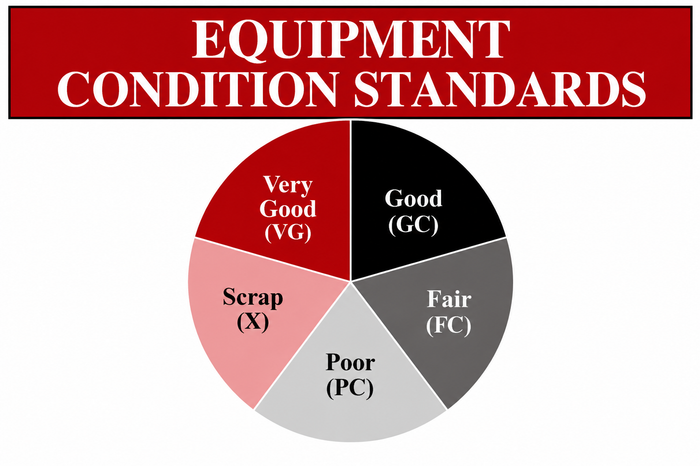
1. Very Good Condition (VG)
Very Good condition describes equipment that remains in exceptionally good mechanical condition and is capable of performing its intended functions.
Machinery in this category typically shows limited deterioration and does not require significant repairs or unusual maintenance. Some equipment may have undergone a major overhaul, while other assets may simply have experienced relatively little use.
For example, a CNC machine that has received consistent maintenance and continues operating near its original specifications may qualify as Very Good.
This classification generally indicates a high level of serviceability compared with other used equipment.
2. Good Condition (GC)
Good condition applies to machinery that remains operational and performs its intended functions despite normal wear.
Equipment in this category may have received previous repairs or modifications. While it continues to operate effectively, certain components may require minor repairs or replacement in the foreseeable future.
A manufacturing machine with moderate operating hours and typical wear on its mechanical components may fall into this category.
Good condition does not mean an asset is free from deterioration. Instead, it indicates that the machinery remains useful and can generally meet its intended operating requirements.
3. Fair Condition (FC)
Fair condition describes equipment that has experienced substantial use and may operate below its original capabilities.
Machinery in this category may require general repairs, adjustments, or replacement of minor components to improve its performance.
For example, an older industrial press with noticeable mechanical wear and reduced operating efficiency may receive a Fair classification.
Although the equipment may still perform useful work, its condition could affect buyer interest and anticipated maintenance expenses.
Appraisers consider these limitations when evaluating the asset’s overall marketability.
4. Poor Condition (PC)
Poor condition applies to machinery with significant deterioration or mechanical limitations.
Equipment in this category may operate substantially below its original specifications. Restoring its performance could require extensive repairs or replacement of major components.
An industrial machine with severe wear, damaged components, or recurring operational failures may qualify as Poor.
The cost of necessary repairs can become an important consideration during valuation.
However, machinery classified as Poor may still have value. Its marketability depends on factors such as repair feasibility, replacement costs, and demand for the particular equipment.
5. Scrap Condition (X)
Scrap condition describes equipment that is no longer serviceable for its intended purpose and has no practical remaining operating utility.
Machinery in this category may have reached the end of its useful life or suffered deterioration that makes restoration impractical.
For example, a severely damaged machine that cannot reasonably return to productive service may be classified as Scrap.
Although the equipment may no longer have value as an operating asset, it may still retain value in recoverable materials.
Scrap value depends on factors such as material composition, recoverable quantities, market prices, and associated removal expenses.
How Equipment Condition Affects Appraisal Value
Physical condition matters in machinery and equipment valuation because it affects an asset’s usability, marketability, and expected maintenance needs.
When evaluating equipment, appraisers may review:
- Physical deterioration: Visible wear, corrosion, damage, and other signs of aging.
- Maintenance records: Documentation of servicing, repairs, and equipment overhauls.
- Operating hours: The extent of machinery use compared with similar assets.
- Mechanical performance: The equipment’s ability to perform its intended functions.
- Repair requirements: The estimated work necessary to maintain or restore operating capability.
These factors help establish an informed understanding of the machinery’s current condition.
For example, two similar forklifts may have the same manufacturing year and comparable specifications. However, one may have received consistent maintenance, while the other requires significant mechanical repairs.
These differences could affect their market values.
Nevertheless, equipment condition standards should not be treated as automatic depreciation percentages. A condition rating is one part of the broader appraisal analysis.
In coastal Florida, saltwater exposure can cause corrosion and deterioration of machinery, reducing its condition rating and overall value. A professional Florida equipment appraisal can help assess these effects.
Why Condition Ratings Matter in Machinery Appraisals
Consistent condition ratings clearly communicate an asset’s physical state.
For lenders, these classifications can provide context when reviewing machinery offered as collateral. Business owners may also find them useful when evaluating existing equipment or preparing for business transactions.
Condition ratings are especially relevant when comparing similar machinery with different maintenance histories or usage levels.
However, a classification’s accuracy depends on the information available to the appraiser.
An onsite inspection may reveal visible deterioration and other physical characteristics. By comparison, a desktop appraisal generally relies on photographs, equipment records, and information supplied by the client.
Neither approach automatically establishes the internal mechanical condition of every component. Any inspection limitations or assumptions should be appropriately disclosed in the appraisal report.
Understanding Equipment Condition Standards in Valuation
Equipment condition standards provide a structured way to describe machinery, from highly serviceable assets to equipment that has reached the end of its practical operating life.
The five classifications help explain differences in wear, performance, and repair requirements. They also provide valuable context when evaluating physical depreciation and marketability.
Still, a condition rating is only one part of a machinery appraisal. A credible valuation also considers the asset’s specifications, market conditions, remaining utility, and the purpose of the appraisal.
At Truman Mox, we provide machinery and equipment appraisal services for businesses, lenders, and other professionals across a wide range of industries.
For professional machinery valuations, contact our team to learn how equipment condition standards can influence the appraisal process.
October 27, 2026 8:32 pm
Comments are closed here.