
Appraising Forklifts: What Determines Value
Appraising forklifts requires careful consideration because these machines are essential assets in warehouses, factories, construction sites, ports, and distribution centers. However, their values can vary greatly.
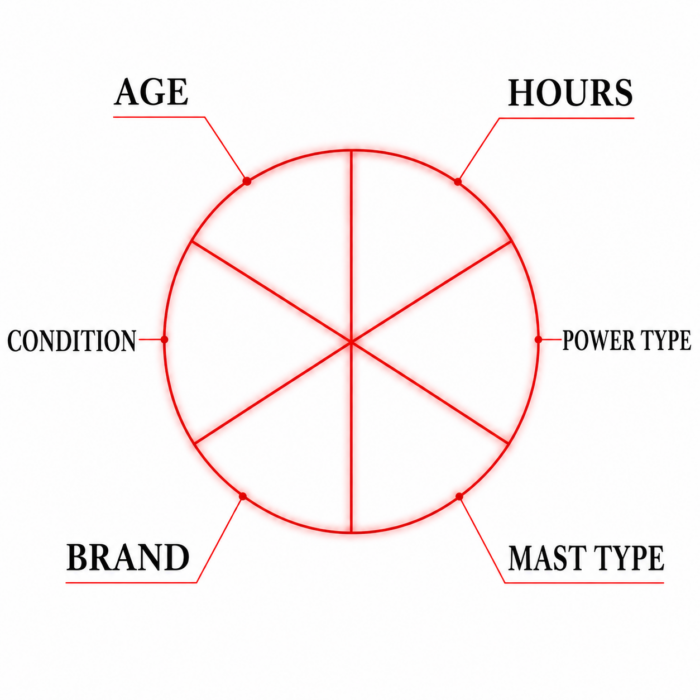
Two similar-looking forklifts may have very different market values. Fuel type, capacity, hours, mast configuration, brand, and condition all affect value.
The operating environment also matters. A forklift stored indoors may age differently than one exposed to rain, humidity, or saltwater.
A qualified appraiser considers these factors together. The goal is to develop a credible value opinion supported by market evidence.
What Is Involved in Appraising Forklifts?
Appraising forklifts begins with identifying the machine and its specifications. The appraiser should collect the manufacturer, model, serial number, year, and rated capacity.
The asset’s configuration must also be documented. Important features include the mast, attachments, tires, fuel type, and overall condition.
An appraiser may also review maintenance records, photographs, hour-meter readings, and ownership history. These details help confirm how the forklift was used.
The intended use of the appraisal also affects the analysis. A lender may request Fair Market Value and Orderly Liquidation Value.
Other assignments may involve insurance, litigation, bankruptcy, mergers and acquisitions, charitable donations, or a proposed sale.
Fuel Type and Forklift Value
Fuel type is one of the first factors considered when appraising forklifts. Most forklifts use electric power, liquid propane, gasoline, or diesel fuel.
Each fuel type serves a different market. Buyer demand often depends on the operating environment and intended application.
Electric Forklifts
Electric forklifts are common in warehouses, food facilities, and indoor manufacturing operations. They produce no direct exhaust emissions during operation.
Electric models are usually quieter than internal-combustion forklifts. They can also have lower routine maintenance requirements.
The battery is a major component of an electric forklift’s value. Industrial batteries can be costly to replace.
The appraiser should consider the battery’s age, condition, capacity, and charging history. A weak battery can reduce the forklift’s marketability.
The charger should also be identified. Buyers often expect a compatible charger to be included in the sale.
Newer lithium-ion systems may command a premium. However, value still depends on brand support, condition, and market acceptance.
LP and Gas Forklifts
Liquid propane forklifts are often called LP forklifts. They are widely used in warehouses, factories, loading docks, and outdoor yards.
LP models can be refueled quickly. This makes them practical for operations with multiple shifts or continuous use.
Gasoline forklifts are less common in some industrial markets. However, they remain useful for certain outdoor and mixed-use applications.
Internal-combustion forklifts require evaluation of the engine, transmission, cooling system, and fuel system. Leaks, smoke, or unusual sounds may indicate mechanical problems.
The availability of replacement parts also affects value. Well-supported models are generally easier to sell and maintain.
How Mast Configuration Affects Value when Appraising Forklifts
The mast determines how high the forklift can raise a load. It also affects where the machine can operate.
Common configurations include simplex, duplex, triplex, and quad masts. Triplex masts are popular because they provide greater lifting height.
A forklift with a high mast may be valuable in a warehouse with tall racking. However, excessive mast height is not useful for every buyer.
Collapsed mast height is also important. A tall collapsed mast may prevent the forklift from entering trailers or low-clearance buildings.
Free lift allows the forks to rise without immediately extending the mast. This feature is valuable inside trailers and confined spaces.
The appraiser should document maximum fork height and collapsed mast height. Hydraulic leaks, chain wear, damaged rollers, and bent rails should also be considered.
Sideshifters, fork positioners, clamps, rotators, and specialized attachments can add value. Their contribution depends on condition and buyer demand.
Appraising Forklifts Based on Hours and Usage
Forklift hours are similar to mileage on a vehicle. They help measure the machine’s accumulated use. When an appraiser is appraising forklifts, this will be considered.
However, hour readings should never be considered alone. The type of work can be just as important as the total hours.
A forklift with 8,000 light-duty hours may remain in good condition. Another machine may show heavy wear after fewer hours.
Multiple-shift warehouse use can accelerate wear. Heavy loads, uneven surfaces, and frequent starts can also affect components.
The appraiser should examine whether the hour meter appears consistent with the machine’s condition. Replaced or nonworking meters require additional caution.
Maintenance records can provide valuable support. Regular service may extend the useful life of a heavily used forklift.
Important mechanical areas include the engine, transmission, steer axle, drive system, hydraulics, brakes, and mast assembly.
Electric units also require an assessment of the battery and electrical system. A low-hour forklift with a failing battery may still require major investment.
Indoor Versus Outdoor Storage
Storage conditions can significantly affect a forklift’s physical condition. Indoor storage generally provides better protection from weather and sunlight.
Outdoor storage exposes equipment to rain, snow, humidity, temperature changes, and ultraviolet light. These conditions can accelerate deterioration.
Seats, hoses, wiring, paint, controls, and tires may all suffer from prolonged outdoor exposure. Water intrusion can also damage electrical components.
Rust should be examined carefully. Light surface oxidation differs greatly from structural corrosion or damaged mast components.
Florida and Saltwater Exposure
Outdoor storage in Florida can create additional concerns. High humidity, intense sunlight, and frequent rain can accelerate wear.
Saltwater exposure is especially important near coastal areas, ports, marinas, and seafood facilities. Airborne salt can promote corrosion.
Salt can affect frames, fasteners, wiring connections, hydraulic fittings, and electrical components. Corrosion may continue beneath paint or protective coatings.
A forklift operating near saltwater may require a downward condition adjustment. The amount depends on the severity and location of the damage.
Photographs should include the undercarriage, mast, battery compartment, engine compartment, and hydraulic connections. These areas may reveal hidden deterioration.
Brand and Manufacturer Support
Brand recognition can have a meaningful effect on forklift value. Established manufacturers often benefit from stronger dealer and parts networks.
Common forklift brands include Toyota, Hyster, Yale, Crown, Raymond, Mitsubishi, Cat, Clark, Komatsu, Doosan, UniCarriers, and Linde.
Brand alone does not determine value. Model popularity, local demand, dealer support, and parts availability also matter.
Toyota forklifts often receive strong market recognition. Crown and Raymond have established positions in electric warehouse equipment.
Hyster and Yale offer broad product lines across many industrial applications. Mitsubishi, Cat, Clark, and Komatsu also have active secondary markets.
Linde equipment may appeal to buyers seeking advanced engineering and operator comfort. However, regional service availability should be considered.
An uncommon brand may still be a capable machine. Yet limited parts access can reduce buyer demand and resale value.
The appraiser should compare the subject with similar models. Adjustments may be needed for brand reputation, specifications, and market support.
Tires, Capacity, and Additional Features
Forklift tires are commonly pneumatic, solid pneumatic, or cushion style. The correct tire type depends on the operating environment.
Cushion-tire forklifts are often used on smooth indoor floors. Pneumatic-tire machines are better suited for uneven or outdoor surfaces.
Worn or damaged tires can be expensive to replace. Their condition should be included in the appraisal analysis.
Rated lifting capacity is another major value factor. Common capacities range from 3,000 pounds to more than 30,000 pounds.
Larger capacity does not automatically mean greater marketability. Specialized heavy-capacity forklifts may have a smaller buyer pool.
Fork length, carriage width, cab configuration, lighting, heating, and safety features can also influence value.
Market Research When Appraising Forklifts
The Sales Comparison Approach is often useful for forklift appraisals. The appraiser researches sales and listings for similar equipment.
Comparable forklifts should have similar capacities, fuel types, mast configurations, ages, hours, and operating features.
Dealer asking prices must be analyzed carefully. An asking price does not confirm that a sale occurred at that amount.
Adjustments may be necessary for condition, location, attachments, tires, battery condition, and dealer preparation.
The Cost Approach may also be considered. This approach can be useful for newer forklifts or specialized units with limited sales data.
The appraiser considers all relevant approaches before selecting the best method. The final conclusion should reflect available data and market behavior.
Why a Professional Forklift Appraisal Matters
Online listings can provide useful information, but they do not tell the entire story. Every forklift has a different history and configuration.
A professional appraisal identifies the asset and explains the factors affecting its value. It also provides support for the final conclusions.
Truman Mox provides independent machinery and equipment appraisals throughout the United States. Our reports support lenders, attorneys, business owners, accountants, and other professional users.
We appraise individual forklifts, large fleets, warehouse equipment, and complete operating facilities. Desktop and on-site appraisal options are available.
Contact Truman Mox to discuss your equipment, intended use, and reporting requirements.
August 23, 2026 11:53 am
Comments are closed here.